Author: admin

  • 8 Secrets to Crafting Blog Post Titles That Will Set the Internet Ablaze

    8 Secrets to Crafting Blog Post Titles That Will Set the Internet Ablaze

    Titles change the destiny of your posts.

    Those few words at the beginning of your blog post can be the difference between the post being read and spread like a virus through the web like a wild fire and it languishing in your archives, barely noticed.

    This month we’ve been talking about how to ‘craft’ blog posts and are looking at key moments in the writing of blog posts that it is important to pause and put a little extra effort into.

    While there will usually only be a handful of words in your post title – they are the most powerful words that you’ll write because for most of your readers the decision as to whether to read the rest of your post rests upon them.

    Why Blog Post Titles Matter

    Blog post titles appear in:

    • Search engine results
    • RSS feeds
    • Links from other bloggers
    • Social media sites
    • On your archive pages (depending upon how you format them)

    In each of these occassions the title can be the only thing that people see and the sole thing that people make the decision to visit your post on. Write a boring, complicated or confusing title and it doesn’t matter what you’ve written in the post – very few people will ever read it.

    What should a Good Blog Post Title Do?

    There are many techniques that copywriters use in crafting titles or headings both online and offline – but there’s generally one common goal behind them all. It can be summed up in the words of David Ogilvy who in Ogilvy on Advertising (a great copywriting book) again and again echoes the refrain that:

    the purpose of a title is to get potential readers to read the first line of your content.”

    This is one of the lessons that has helped me the most in my own blogging and I’ve seen it’s power again and again.

    Write a captivating and intruiging title and you’ll draw people into reading it every time.

    How to Craft a Blog Post Title – 8 Tips

    How do you craft a blog post title that get people to read your blog posts opening lines?
    There are many techniques for crafting blog post titles that will draw readers into them. Below I’ll outline a few (you won’t be able to do all of them in every single post).

    Before I share them – let me give one universal tip – Don’t Rush – this is the main point of this whole series on crafting content. If there’s nothing else you come away from today – take away that if you rush your titles you could well be wasting the time that you invest into your actual posts. Invest time into your posts, it’s something that will pay off!

    Now that we’re taking our time – here are 8 tips that I use in the creation of blog post titles. Note: you’d not be likely to use all of them in the one post (although for fun I did my best to get quite a few of them into the image title above). Different techniques will work better in different situations.

    1. Communicate a Benefit

    This is SO IMPORTANT. If a potential reader comes across your post in Google search results or your RSS feed or on a site like Digg and they see a title that promises to meet a need they have – they’ll click that link on almost every occassion. Identify a need in of potential readers (we talked about this in yesterdays post) and communicate that your post will solve this problem or need in your title. This is why posts with titles like ‘How to Hold a Digital Camera’ and ’10 Ways to Take Stunning Portraits’ (LINKSSSSSSS) have driven hundreds of thousands of readers to my photography blog in the last year. They are not ‘clever’ or ‘cryptic’ titles – they simply SCREAM at those that see them what they’ll get if they visit the post. These titles don’t draw everyone that see’s them to them, but they’ll certainly draw in people with the needs that you’re aiming the post at.

    2. Create Controversy or Debate

    Another technique that can be very good at drawing people into a post is to set the scene for controversy, debate or a strong opinion. You need to be willing to back these types of titles up with posts that reflect the title – but controversy is one of those things that tends to pique people’s interest. Keep in mind that when you create controversy you’ll attract strong reactions in people.

    3. Ask a Question

    When you ask a question those who read it are wired to respond (or to see what the response is). I find that questions at post titles can be very popular at not only drawing in readers – but particularly effective at getting readers to leave comments – particularly if the comment directs a question AT the reader (ie use the word YOU in the question) rather than just being a random question. I’ll write more on personalizing titles below.

    4. Personalize Titles

    When you write blog posts you are potentially writing to vast audiences of many thousands of readers – however readers can feel like the post is laser targetted in on their own specific situation, particularly if you personalize the language that you’re using. One of the easiest ways to do this is simply to use the word ‘you’ in your posts. I wrote a little about this in First Person Blogging about ‘You’ but mainly talked about using the word ‘you’ in the post itself but in the title of your posts it can have an even bigger impact. Example – 21 Ways to Make Your Blog or Website Sticky.

    5. Use Keywords

    Keywords in titles are good for two main reasons:

    • Firstly they grab the attention of readers who are scanning content – I noticed this recently when I was in a buying mode looking to get an iPhone. Anytime any post in my RSS feeder had the word ‘iPhone’ it was like a flashing light and attracted my attention to it. I could hardly help it but because I was on the look out for information to help me with that purchase the keyword was a great attention grabber.
  • Mastering Engaging Opening Lines: 11 Creative Strategies to Hook Your Readers

    Mastering Engaging Opening Lines: 11 Creative Strategies to Hook Your Readers

    My wife’s first words to me were…

    ‘Hi Michael, it’s nice to meet you’

    …which was both funny and memorable since my name is DARREN, not Michael!

    Ever wondered how some posts keep you hooked while others don’t catch your eye?

    It’s all in the opener. The first words you utter or write can set the tone for any relationship or conversation…

    Just like in real life, the opening lines of your blog post can make or break your reader’s engagement.

    In my last post in this ‘how to craft a blog post’ series I identified your blog’s title/headline as the most important words that you’ll write in a blog post and I said that the purpose of the title is to get people to read your opening line.

    The second most important words in your blog post are those that follow the title – your opening line. Their purpose is to get people to read the next line – to draw people deep within your post. Here’s how you can craft compelling opening lines to captivate your readers from the get-go.

    11 Effective Strategies for Blog Post Openers

    So how does one craft an opening line to a post that effectively engages readers and stimulates enough interest to get them to read your blog post? Here are a few tips that I’ve found helpful.

    1. Identify a Need

    Kick off your post by pinpointing a reader’s problem or need.

    Sound familiar? It should – I’ve talked about reader needs and problems in my post about choosing a topic and crafting your post title.

    If you haven’t got it by now you should be starting to see that I place a lot of importance on identifying a reader’s need and solving it as a key to writing successful blog posts. You don’t have to solve the need or problem in the opening line but an effective way to get readers to read deep into your post where you do solve it is to tell them that you will in the opening line.

    2. Ask a One-Answer Question

    Engage readers immediately by posing a question that nudges them to say “yes”. This is a technique that copywriters have been using for a long time and it works. I did it in the first line of this post: “Ever wondered how some posts keep you hooked while others don’t catch your eye?”.

    Asking this type of question does a couple of things. For starters you’re communicating what the post is about and the need that it will fulfill in the reader; but secondly (and more importantly) you’re drawing out a response in your reader and one which puts the need that your post will solve squarely in their mind. Anyone reading and answering ‘yes’ to my question above enters into this post having just said that they want to discover how to write engaging opening lines – this ‘buy in’ helps in the communication process that follows.

    Asking ‘yes’ questions can actually be something you use more than once in a post. Ask a series of them scattered through your post and you can actually take your reader on a journey that leads them to your call to action.

    3. Pose an Intriguing Question

    Spark curiosity with a question that promises an interesting revelation and leaves readers eager for the answer.

    Questions like:

    • “What do Bill Gates and Martha Stewart have in common?”
    • “How did I take my subscriber numbers from 0 to 51,346?”
    • “Is the Nikon D700 the best Digital SLR Camera Ever Invented?”

    All of these questions will appeal differently to different audiences – but all leave readers wondering what the answer will be and give them a reason to read on further into a post.

  • 55 most popular blog examples you need to check out for inspiration

    55 most popular blog examples you need to check out for inspiration

    A blog is a type of website that presents frequently updated content in reverse chronological order, with the newest entries appearing first. It’s an excellent tool for self-expression, building social connections, improving writing skills, and promoting businesses.

    For many, blogging can also be profitable through various methods, such as affiliate marketing and displaying ads.

    Whichever blogging goal you have in mind, exploring existing blogs is a great kickstart before building your own blog. To help you with that, we’ve compiled 55 blog examples in multiple niches:

    • Tech blogs – TechCrunch, The Verge, Engadget, Gizmodo, 9to5Mac
    • Lifestyle blogs – Cup of Jo, Minimalism Life, Girlboss, Men’s Journal, Treehugger
    • Beauty and fashion blogs – He Spoke Style, The Zoe Report, Sincerely Jules, Color Me Courtney, Fashion Jackson
    • Health and fitness blogs – The Fitnessista, Muscle and Fitness, Fit Bottomed Girls, MyFitnessPal Blog, Ben Greenfield Life
    • Education blogs – HowStuffWorks, TED-Ed Blog, I Heart EDU, The Chronicle of Higher Education
    • Business and marketing blogs – Business 2 Community, BloggersPassion, Ahrefs, Antavo
    • Finance and investment blogs – CoinDesk, The Penny Hoarder, Ramsey Solutions, Timothy Sykes, Of Dollars And Data
    • Food blogs – Pinch of Yum, Minimalist Baker, Green Kitchen Stories, The Woks of Life, Fit Men Cook
    • Travel blogs – The Blonde Abroad, Wandering Earl, Nomadic Matt, HoneyTrek, Anywhere We Roam
    • Photography blogs – Joe McNally, David duChemin, Photofocus, The Sartorialist
    • Art and design blogs – Apartment Therapy, Abduzeedo, Colossal, Booooooom, Hookedblog

    Continue reading to uncover our complete list of blog examples and what you can learn from them.

    Best tech blogs

    If you’re a tech junkie, you may want to share your passion through a blog.

    A tech blog usually features the latest news on technology and its applications in various fields such as science, entertainment, and business. Some technology blogs also feature reviews of newly released gadgets, making it one of the most profitable blog niches you can choose.

    Here are some popular technology blogs:

    1. TechCrunch

    TechCrunch's blog homepage
    • Main topics: technology and startup news
    • Created on: WordPress VIP

    A leading source for technology and startup news, TechCrunch covers everything from the latest developments in Silicon Valley to venture capital funding.

    The blog’s target audience is technology and business enthusiasts, especially startup founders and investors worldwide.

    What can we learn from this blog?

    TechCrunch’s clean web design prioritizes text readability with its green background and white text.

    Headlines of the most recent articles are shown neatly on the homepage and accompanied by snippets from blog posts and relevant pictures to add a splash of color.

    To increase engagement, TechCrunch also displays its most popular posts on the right side of the website.

    2. The Verge

    The Verge blog homepage
    • Main topics: technology, science, entertainment
    • Created on: Chorus

    Focused on exploring how technology will shape the future, The Verge offers in-depth analysis and reporting.

    This blog provides news and opinion pieces on the latest technological developments in art, culture, and science for the mainstream audience.

    What can we learn from this blog?

    The Verge’s website homepage is vibrant – a black-and-white theme with bright green accents.

    Beneath the navigation bar, a collage of bold headlines and images draws visitors’ attention, while the vertically placed blog title reinforces its tech-focused style.

    In addition, teaser blog content is displayed by scrolling down the homepage for easy access, such as featured videos and reviews.

    3. Engadget

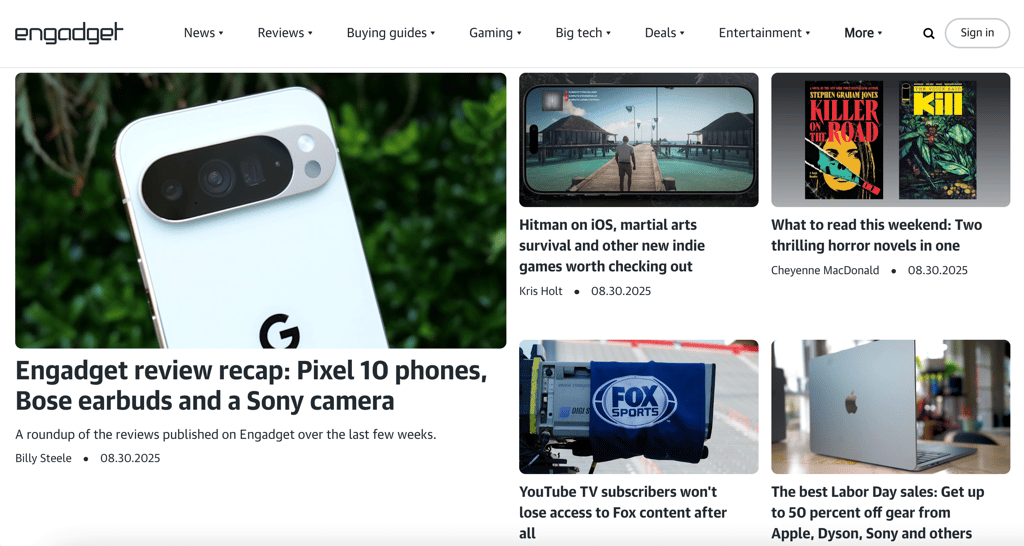
    Engadget blog homepage
  • How to Start A Blog in 2026

    How to Start A Blog in 2026

    Updated July 16th, 2026

    Are you looking for an easy guide on how to start a blog?

    The step-by-step guide on this page will show you how to create a blog in 20 minutes with just the most basic computer skills.

    Ready to start? Click here to skip to Step #1 of the free guide and start building your blog now!

    After completing this guide you will have a beautiful blog that is ready to share with the world.

    This guide is made especially for beginners. I will walk you through each and every step, using plenty of pictures and videos to make it all perfectly clear.

    If you get stuck or have questions at any point, simply send me a message and I will do my best to help you out.

    How to start a blog for beginners

    My name is Scott Chow, and I am going to show you how to start blogging today. I have been building blogs and websites since 2002. In that time I have launched several of my own blogs, and helped hundreds of others do the same.

    I know that starting a blog can seem overwhelming and intimidating. This free guide is all about blogging for beginners, and will teach you how to become a blogger with just the most basic computer skills. So whether you’re 8 or 88, you can create your own blog in 20 minutes.

    I am not ashamed to admit that when I was first learning how to build a blog I made a ton of mistakes. You can benefit from more than a decade of my experience so that you don’t repeat these same mistakes when you make your own blog. I created this free guide so that a complete beginner can learn how to blog quickly and easily.

    So, just how do you start a blog?

    Learn how to create a blog in about 20 minutes following these steps:

    How to Start a Blog in 6 Steps

    1. Pick a blog name. Choose a descriptive name for your blog.
    2. Get your blog online. Register your blog and get hosting.
    3. Customize your blog. Choose a free blog design template and tweak it.
    4. Write & publish your first post. Share your thoughts with the world. The fun part!
    5. Promote your blog. Get more people to read your blog with the proper marketing.
    6. Make money blogging. Choose from several options to monetize your blog.

    Should you start a blog?

    One of the misconceptions about starting a blog is that you need to be a great writer to be successful. Nothing could be further from the truth. People read blog sites to get a personal perspective on things, so most bloggers write in a very informal and conversational style.

    And because of the format, many successful bloggers will write about a variety of topics on the same blog.

    In addition, you don’t need to be an expert on any of the topics you write about to have a successful blog. For example, visitors to a cooking blog don’t want to read a textbook from a food scientist, they want to hear the experiences of someone who has actually cooked some real meals, mistakes and all.

    To be successful as a blogger there is really just one requirement: a passion for your topic.

    At its heart, blogging is about sharing your knowledge with the world. Writing about things that you are passionate about makes the process of starting a successful blog so much easier. As long as you are writing about things that you are genuinely interested in, your passion will shine through and keep your visitors interested.

    So why would you go to the trouble of blogging? There are a few reasons:

    • Share your story. A blog allows you to have a voice and be heard. You can share your story with the entire world if you so choose. One of the most common ways blogs are used are as a diary where the blogger writes about their daily experiences so that friends, family, and others can all be a part of their lives.
    • Make money from home. Blogging can be quite lucrative if done correctly. The top bloggers in the world obviously earn quite a bit, but even a part-time blogger can expect to make a nice profit if things are done correctly. The best part about it is that blogging is a form of passive income, since you can spend just a few hours a week writing a piece of content and then continue to profit from it long after the the writing is finished. I go into much more detail on how to blog for money later in this guide.
    • Recognition for yourself or your business. No, you probably won’t have paparazzi following you around because of your latest post. But a successful blog makes your idea into a reality, and can gain you a ton of recognition in your respective field. Many bloggers are known as experts just because of their blogs, and some have even gotten book and movie deals based on their blogs.
    • Find a community. Blogging at its heart is interactive. You write a post and people comment on it. This is a good way to connect with people who are interested in the same things as you are. Blogging allows you to teach these people based on your experience, and it gives you the opportunity to learn from your readers as well.

    Ready to begin? Click here to go to Step #1 of the guide

    What is a blog anyway?

    In short, a blog is a type of website that focuses mainly on written content, also known as blog posts. In popular culture we most often hear about news blogs or celebrity blog sites, but as you’ll see in this guide, you can start a successful blog on just about any topic imaginable.

    Bloggers often write from a personal perspective that allows them to connect directly with their readers. In addition, most blogs also have a “comments” section where visitors can correspond with the blogger. Interacting with your visitors in the comments section helps to further the connection between the blogger and the reader.